ChatGPT for Trades & Local Businesses: Practical Guide
How Trades & Local Businesses Can Actually Use ChatGPT to Save Time and Grow
AI is everywhere right now, but there’s a big difference between having access to ChatGPT and actually knowing how to use it for your business.
For many tradespeople and local business owners, using ChatGPT starts and ends with something like:
“Write me a Facebook post for my plumbing business.”
It’ll give you an answer. But it probably won’t sound much like your business.
That’s because ChatGPT doesn’t automatically know who you are, what services you offer, where you work, what type of customers you want, how you price jobs or what makes your business different.
The better approach is simple:
Teach AI about your business first. Then ask it to help you.
Why Generic Prompts Give Generic Results
Imagine hiring someone to handle your marketing without telling them anything about your company.
You wouldn’t just say:
“Get me some customers.”
You’d explain what you do, where you operate, which services you want to sell, who your ideal customers are and what makes you different from competitors.
AI works in a similar way.
The more useful business context you provide, the better chance it has of producing something relevant.
Instead of:
“Write a Facebook post.”
You could tell ChatGPT that you're an electrician covering Middlesbrough and surrounding areas, specialise in domestic work, want more rewires and consumer-unit enquiries, offer free quotations and prefer straightforward, friendly language.
Now it has something meaningful to work with.
Start by Teaching ChatGPT About Your Business
Before using AI every day, create a basic Business AI Profile.
Give ChatGPT information such as:
Business name and trade
Services you provide
Areas you cover
Services you particularly want to promote
Ideal customers
Typical customer questions and concerns
Pricing information you're happy for it to use
Your main competitors or differentiators
Qualifications and accreditations
Guarantees you genuinely offer
Your preferred tone of voice
Your current business goals
You can also tell it something extremely important:
Never invent information about the business. If something important is missing, ask me.
That one rule can make AI considerably safer and more useful for business work.
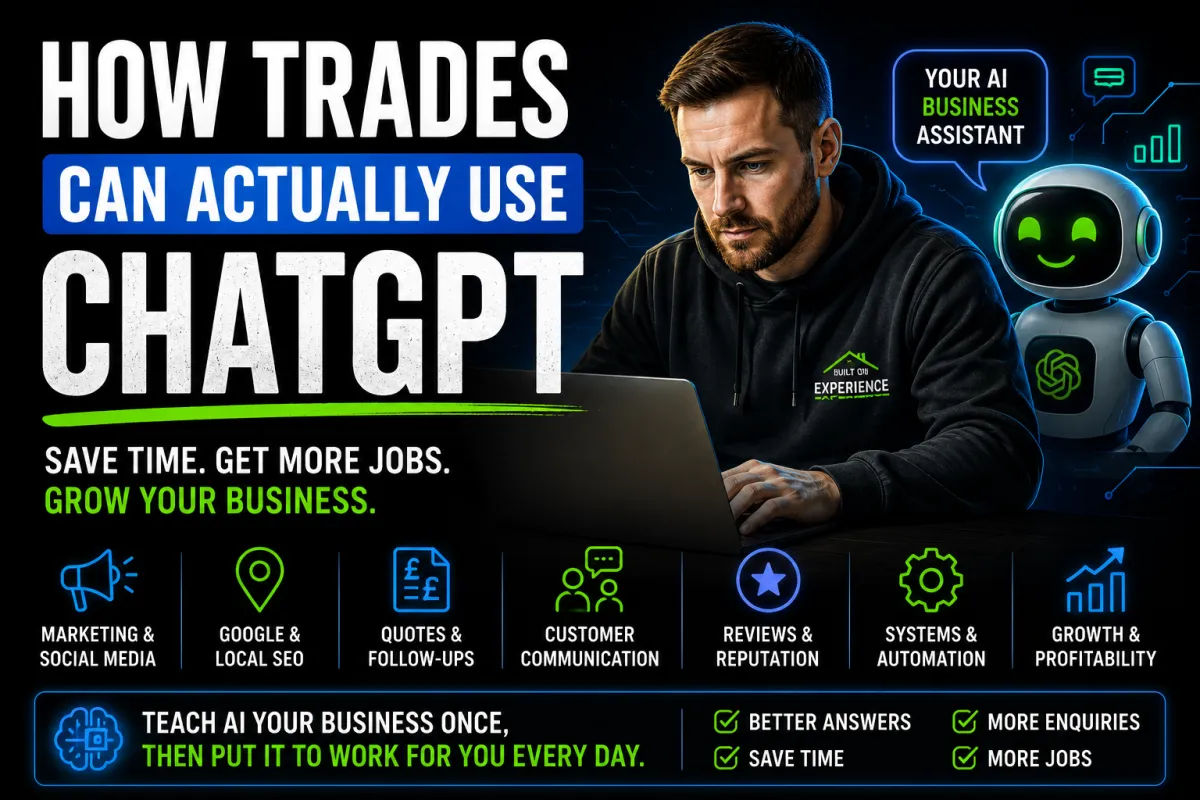
6 Ways Trades Can Start Using AI
Once ChatGPT understands your business, there are plenty of everyday jobs it can help with.
1. Marketing & Social Media
Running out of things to post is one of the easiest problems to solve with AI.
Instead of constantly posting:
“Another job completed. Message us for a quote.”
AI can help turn your knowledge and completed jobs into:
Educational posts, FAQs, before-and-after captions, seasonal campaigns, promotional offers, short video ideas and posts addressing common customer concerns.
A landscaper could turn one completed patio into several different pieces of content rather than posting the same three photographs once and forgetting about them.
2. Google & Local Visibility
For a local business, being visible when somebody searches for your service can be incredibly valuable.
AI can help you plan content around the services and locations your customers actually search for.
For example, a recovery company could explore content around:
Car Recovery Middlesbrough
Breakdown Recovery Stockton
24 Hour Vehicle Recovery Teesside
It can also help generate ideas for Google Business Profile updates, FAQs, service descriptions and website pages.
AI isn't a magic button that automatically puts you at the top of Google, but it can make researching and producing useful local content considerably quicker.
3. Quotes & Follow-Ups
How many quotations get sent out and are never followed up?
This is an area where a simple AI-assisted process can help.
Tell ChatGPT what was quoted, when it was sent and the situation.
Then ask it to create an appropriate follow-up.
For example:
Day 2: Friendly check-in.
Day 5: Ask whether they have any questions.
Day 10: Final follow-up without sounding desperate.
You can also use it to help respond when someone says:
“That's more expensive than I expected.”
Instead of immediately knocking money off the quote, you can formulate a professional response explaining the value of the work.
4. Customer Communication
Business owners write the same types of messages constantly.
Appointment confirmations.
Quote responses.
Missed-call messages.
Job updates.
Review requests.
Complaint responses.
Aftercare messages.
AI can help you create templates for these situations while still allowing you to personalise the final message.
That can save a surprising amount of time over a month.
5. Reviews & Reputation
Getting the job finished shouldn't necessarily be the end of the customer journey.
You can use AI to build a simple process:
Job completed → thank customer → request review → follow up if appropriate → ask for referral → stay in touch.
It can also help draft professional responses to positive and negative reviews.
The important part is to give AI the real facts.
Never have it invent an explanation, guarantee or resolution that you haven't authorised.
6. Pricing, Profit & Business Growth
This is where AI becomes more interesting than simply writing social media posts.
You can give ChatGPT non-sensitive business information and ask it to help you think through questions such as:
Which services appear to make us the most money?
Which jobs consume the most time?
Where are we wasting time each week?
Which services should we promote more heavily?
What repetitive admin could potentially be automated?
What information should we start tracking?
AI shouldn't blindly make important financial decisions for you.
But it can be extremely useful for organising information, challenging assumptions and spotting questions you haven't considered.
AI Should Assist Your Business — Not Run It Blindly
There is one major rule every business owner should understand.
ChatGPT can be wrong.
Don't automatically publish or send everything it produces.
Check important information, especially:
Prices, regulations, qualifications, guarantees, technical advice, customer commitments and anything safety-related.
Think of AI as an extremely fast assistant.
Give it good information and good instructions, then you make the final decision.
The Biggest Opportunity Isn't Better Prompts
Prompts are only the beginning.
Once you identify tasks where AI genuinely saves you time, you can start building processes around them.
For example:
New enquiry → qualification → quote → follow-up → booking → job completion → review request → referral request.
You don't necessarily want AI controlling every part of that process.
But you can identify where AI, templates and automation could remove repetitive work while keeping important customer interactions human.
Start With One Problem
Don't try to “AI automate” your entire business tomorrow.
Pick one thing that currently wastes your time.
Maybe it's social media.
Maybe it's following up quotations.
Maybe it's replying to enquiries.
Maybe it's writing website content.
Teach ChatGPT enough about your business to understand the situation, give it clear instructions and see whether it genuinely makes the job easier.
Then move onto the next problem.
That's where AI becomes useful — not because it's fashionable, but because it gives you time back to actually run your business.
Want the Complete System?
I've put together The Trades AI Playbook for trades and local service businesses that want to go much further.
It contains 160+ advanced ChatGPT prompts, workflows and business systems, including the Business AI Master Prompt, Business Knowledge Interview, marketing, Google and local SEO, websites, leads, quotes, follow-ups, customer service, reviews, pricing, operations, growth and a 30-day implementation plan.
The Trades AI Playbook — £29.99 one-off.
No subscription. Instant digital access.
Teach AI your business once. Then put it to work.

